如同许多濒临破裂的关系一样,自唐纳德·特朗普一年前重返白宫以来,这段关系就充满了争吵、暗流涌动的紧张气氛以及在公众面前勉强维持体面的努力。
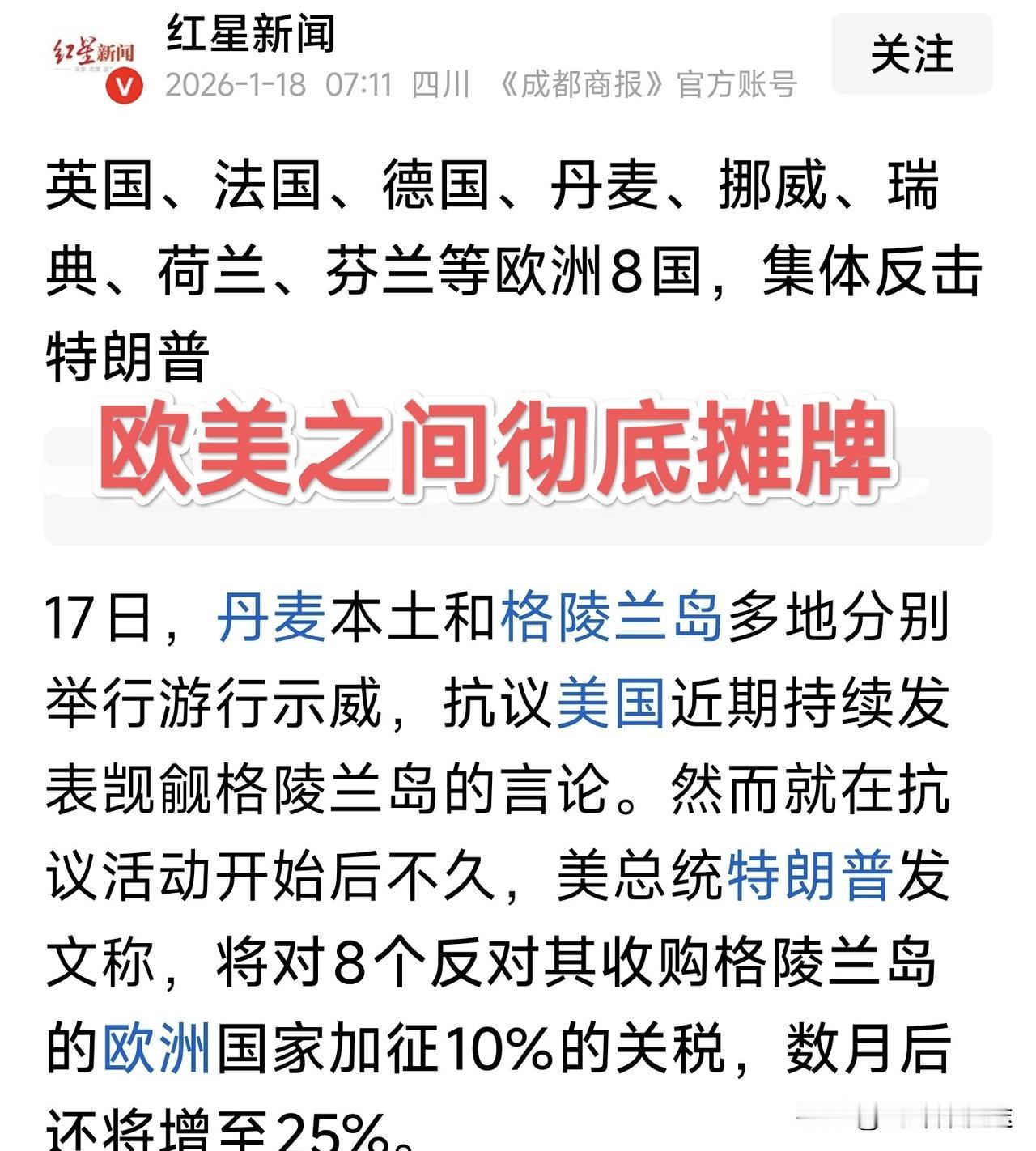
但对于包括美国最长久、最忠诚的盟友在内的许多欧洲国家政府而言,特朗普威胁要对任何试图阻止他吞并格陵兰岛的国家征收惩罚性关税,这成了压垮骆驼的最后一根稻草。他们认为,这段关系的破裂已不可避免。
私下里,沮丧的欧洲官员将特朗普急于吞并这块丹麦主权领土的行为形容为“疯狂”和“荒谬”,并质疑他是否在委内瑞拉事件后又陷入了“好战模式”。他们表示,特朗普理应受到欧洲最严厉的报复,因为在许多人看来,这是对大西洋彼岸盟友的公然且无端的“攻击”。
“我认为这太过分了,”一位欧洲外交官说,他和其他一些人一样,为了坦诚发言而要求匿名。 “欧洲因对特朗普态度软弱而饱受诟病。这固然有一定道理,但欧洲也有底线。”
欧洲高级官员越来越相信,现在是时候正视现实了:特朗普领导下的美国已不再是可靠的贸易伙伴,更遑论可靠的安全盟友,他们必须着眼未来。“美国政策正在发生转变,而且在很多方面都是永久性的,”一位欧洲政府高级官员表示,“等待并非解决之道。我们需要的是有序协调地迈向新的现实。”
这种协调工作已经开始,关于下一步走向的重大讨论也已展开。
除非美国彻底改变其策略,否则这一进程很可能导致西方格局的彻底重塑,从而颠覆全球力量平衡。其影响范围广泛,从贸易紧张局势加剧造成的跨大西洋经济损失,到欧洲在尚未做好充分准备的情况下,试图在没有美国援助的情况下捍卫自身安全所带来的安全风险。
美国也可能付出代价,例如,在无法利用欧洲目前提供的基地、机场和后勤支持网络的情况下,其向非洲和中东投射硬实力的能力将受到影响。
除了各种关于通过打击美国贸易进行报复的讨论之外,各国首都的外交官和政府官员也在考虑与华盛顿长期决裂可能带来的后果。
对大多数人来说,前景令人痛苦,这将终结长达80年的和平合作、互助和互利贸易,并对北约目前的形态造成致命打击。许多国家政府都希望尽力挽回局面,而意大利极右翼领导人乔治娅·梅洛尼则试图重建关系。
但对一些政府官员来说,西方盟友在后美国时代的未来并不难想象。
首先,包括英国和挪威等非欧盟成员国在内的欧洲国家,在特朗普第二个任期内,一直在一个日益高效的联盟中开展合作,而这个联盟的运作早已超越了美国的范畴:即所谓的“愿意支持乌克兰的联盟”。
来自35个国家的国家安全顾问保持着定期联系,他们经常在线上线下会面,也通过非正式的短信进行交流。他们习惯于在特朗普本身就是问题一部分的当下,寻求多边解决方案。
据熟悉该联盟运作方式的人士透露,这些圈子内部的信任度普遍很高。而且这种信任不仅存在于官员层面:各国领导人也积极参与其中,在新的紧密合作小组中开展工作。
包括英国首相基尔·斯塔默、法国总统埃马纽埃尔·马克龙、德国总理弗里德里希·默茨,以及欧盟委员会主席乌尔苏拉·冯德莱恩、芬兰总理亚历山大·斯图布和意大利总理梅洛尼在内的领导人经常互发短信——而且往往是在同一个群聊中。
过去一年,每当特朗普做出一些出格且可能造成损害的举动时,他们都会形成一套行之有效的沟通机制,即通过群聊传递信息。“当事态发展迅速时,协调起来就比较困难,而这个群聊机制非常有效,”一位知情人士表示,“这充分体现了人际关系的重要性。”
这种“非正式但活跃”的机制被称为“华盛顿集团”,得名于去年8月陪同乌克兰总统泽连斯基访问白宫的欧洲领导人。
过去一年,他们的做法主要是保持冷静,并对特朗普的政策行动做出回应,而不是被他挑衅性的言论所激怒。这种精神推动了乌克兰和平进程,各方正在就一项美国已签署的和平计划框架达成一致——其中包括美国对乌克兰的安全保障。考虑到特朗普此前曾排除美军参与的可能性,这无疑是一项重大成就。
但特朗普在格陵兰问题上的鲁莽举动如今已彻底改变了局势。
以往对美国总统威胁采取的温和态度已不复存在。就连一向谨慎的斯塔默也公开谴责总统的关税威胁“错误”,而且显然他还在周日与特朗普进行了直接通话。
格陵兰危机让人们开始思考,如何在没有美国支持的情况下继续前进。
“‘自愿联盟’最初是为了解决乌克兰问题而成立的,”另一位外交官表示,“但它在一些关键人物之间建立了非常紧密的联系。他们一直在建立信任,也培养合作能力。他们彼此熟识,联系和发送短信都很方便。”
在如今美国不再支持北约和欧洲安全的时代,这种模式有可能成为建立新的安全联盟的温床。新的安排不会排除与美国的合作,但也不会将其视为理所当然。
泽连斯基本人也参与了与华盛顿集团领导人的文字聊天,这引出了另一个耐人寻味的观点。在所有与会国家中,乌克兰的军事化程度无疑是最高的,它拥有庞大的军队、高度精密的无人机生产产业,以及比任何其他国家都更丰富的战争实战经验。
尽管乌克兰长期以来一直寻求加入北约,但如今加入北约似乎已不再像以前那样令人向往,因为美国承诺的安全保障正日益失去说服力。
如果将乌克兰的军事实力纳入考量,再加上法国、德国、波兰和英国等国的军事力量,这个“自愿联盟”的潜在武装力量将十分庞大,而且将涵盖核国家和无核国家。
尽管欧洲需要在减少美国支持的情况下自卫已是老生常谈,但近来布鲁塞尔方面却频频提出相关倡议,并发布了一系列相关新闻。欧盟官方已决定在2030年前具备自卫能力。
一周前,欧盟防务专员安德留斯·库比柳斯提议建立一支10万人的欧盟常备军,并重提设立一个由约12个成员国(包括英国)组成的欧洲安全理事会的想法。冯德莱恩大力宣传一项新的欧洲安全战略,但目前尚未公布太多细节。
各方普遍认为,关于新的欧洲安全架构的对话必须尽快展开。欧盟领导人将在未来几天举行紧急峰会,商讨如何应对特朗普对格陵兰岛的威胁,但讨论内容可能远不止于此。
由于特朗普将出席在达沃斯举行的世界经济论坛,欧洲和美国方面也有可能举行面对面会谈。
在与默茨、马克龙、斯塔默和北约秘书长马克·吕特通话后,冯德莱恩周日表示,欧洲人将“坚定不移”地履行保护格陵兰岛的承诺。她说:“我们将以沉着和决心应对这些对欧洲团结的挑战。”
鉴于当前形势,我们也需要一些创造性的思维。
As with many failing relationships, it’s been a story of arguments, unspoken tensions and trying to keep up appearances in public since Donald Trump re-entered the White House ayear ago.
But for many European governments, including America’s longest-standing and most loyal allies, Trump’s threat of punitive tariffs against anyone who tries to stop him taking Greenland was the final straw. Divorce, they believe, is now inevitable.
In private, dismayed European officials describe Trump’s rush to annex the sovereign Danish territory as “crazy” and “mad,” asking if he is caught up in his “warrior mode” after his Venezuela adventure — and saying he deserves Europe’s toughest retaliation for what many see as a clear and unprovoked “attack” against allies on the other side of the Atlantic.
“I think it is perceived as one step too far,” said one European diplomat, who like others was granted anonymity to speak candidly. “Europe has been criticized for being weak against Trump. There is some truth in that, but there are red lines.”
Senior European officials increasingly believe it’s time to face the truth that Trump’s America is no longer a reliable trade partner, still less a dependable security ally, and urgently look to the future. “There is a shift in U.S. policy and in many ways it is permanent,” according to a senior official with a European government. “Waiting it out is not a solution. What needs to be done is an orderly and coordinated movement to a new reality.”
That coordination has already begun, as has the big conversation about what comes next.
Barring a radical shift in the approach of the United States, this process seems likely to end in a radical reshaping of the West that would upend the global balance of power. The implications range from transatlantic economic damage as trade tensions rise, to security risks as Europe attempts to defend itself without American help before it is fully ready to do so.
There would likely be costs to the United States as well, such as in its ability to project hard power into Africa and the Middle East without access to the network of bases, airstrips and logistical support that Europe currently provides.
Alongside all the talk of retaliation by targeting U.S. trade, diplomats and government officials in national capitals are also considering what a long-term split from Washington might bring.
For most the prospect is a painful one, ending 80 years of peaceful cooperation, mutual support and profitable trade and dealing a death blow to NATO in its current form. Plenty of governments want to salvage what they can, while Italy’s hard right leader, Giorgia Meloni, is trying to rebuild relations.
But for some government officials, a post-U.S. future for Western allies isn’t hard to imagine.
For starters, European states, including those not in the EU like Britain and Norway, have spent much of Trump’s second term working in an increasingly effective group that already operates without America: the so-called coalition of the willing to support Ukraine.
National security advisers from 35 governments are in regular contact, meeting frequently online and in person, as well as interacting via less formal text messaging. They are accustomed to seeking multilateral solutions in a world where Trump is a big part of the problem.
Levels of trust in these circles are generally high, according to people familiar with the way the group operates. Nor is it just at the level of officials: National leaders are themselves rolling up their sleeves and working in intimate new groupings.
Leaders including the U.K.’s Keir Starmer, France’s Emmanuel Macron and Germany’s Friedrich Merz, as well as European Commission President Ursula von der Leyen, Alexander Stubb of Finland and Meloni of Italy regularly text with each other — often in the same group chat.
Over the past year they have developed a well-drilled routine of exchanging messages whenever Trump does something wild and potentially damaging. “When things start moving quickly, it’s hard to do the coordination, and this group [chat] is really effective,” saidone person familiar with the arrangement. “It tells you a lot about the personal relationships and how they matter.”
The “informal but active” arrangement is known as the Washington Group, after the collection of European leaders who visited the White House with Ukraine’s President Volodymyr Zelenskyy last August.
Their approach for the past year has mostly been to keep calm and respond to his policy actions rather than taking the bait of his provocative words. That ethos has oiled the wheels of the Ukraine peace process, with the coalition of the willing closing in on a framework for a peace plan that the U.S. is signed up to — including American security guarantees for Ukraine. This marks a significant achievement given that Trump earlierruled out the U.S. military playing a role.
But Trump’s hell-raising over Greenland has now tipped the balance.
Gone is the softly-softly approach to the American president’s threats. Even Starmer, normally the most circumspect of leaders, called out the president’s tariff threat as “wrong,” including, apparently, in a direct call with Trump on Sunday.
The Greenland crisis has focused minds on the question of how to move on without America by their side.
“The coalition of the willing started as being about Ukraine,” said another diplomat. “But it has created very close ties between some of the key people in the capitals. They have been building up trust and also aptitude to work together. They know each other by name and it’s easy to reach out and to send texts.”
This format could potentially become the seedbed for a new security alliance in an era when the U.S. no longer supports NATO and European security. A new arrangement wouldn’t exclude cooperation with America, but nor would it take it for granted.
Also in the text chats with the Washington Group leaders is Zelenskyy himself, which brings another intriguing idea into the mix. Ukraine is by far the most militarized country among those represented, with a huge army, a highly sophisticated drone production industry, and more expertise in the realities of fighting a war than anyone.
While Ukraine has long sought membership in NATO, that nowseems less of a prize than it once did, as America’s promises to underpin any security guarantees grow less convincing by the day.
If Ukraine’s military might were to be included, when added to that of France, Germany, Poland and the U.K., among others, the potential armed power of the coalition of the willing would be vast, and would include both nuclear and non-nuclear states.
Although Europe’s need to defend itself with less American support is an old topic of conversation, recent days have seen a flurry of initiatives and headlines from Brussels. Officially, the EU has resolved to be able to defend itself by 2030.
European Defense Commissioner Andrius Kubilius a week ago proposed a standing EU army of 100,000 personnel and revived the idea of a European Security Council of around 12 members, including the U.K. Von der Leyen touted a new European Security Strategy, though few details have yet been provided.
There is wide agreement that these conversations about a new European security architecture need to happen, and fast. EU leaders will meet in person for an emergency summit in the coming days to calibrate a response to Trump’s Greenland threats, though the discussion may range far wider than that.
With Trump due to attend the World Economic Forum in Davos, there is also a possibility of face-to-face talks between the European and American sides.
After speaking to Merz, Macron, Starmer and NATO chief Mark Rutte, von der Leyen said on Sunday that Europeans would “stand firm” in their commitment to protect Greenland. “We will face these challenges to our European solidarity with steadiness and resolve,” she said.
Given the current moment, some creative thinking will also be required.